
Stamped Concrete Patios in Rosenberg, TX: A Complete Guide
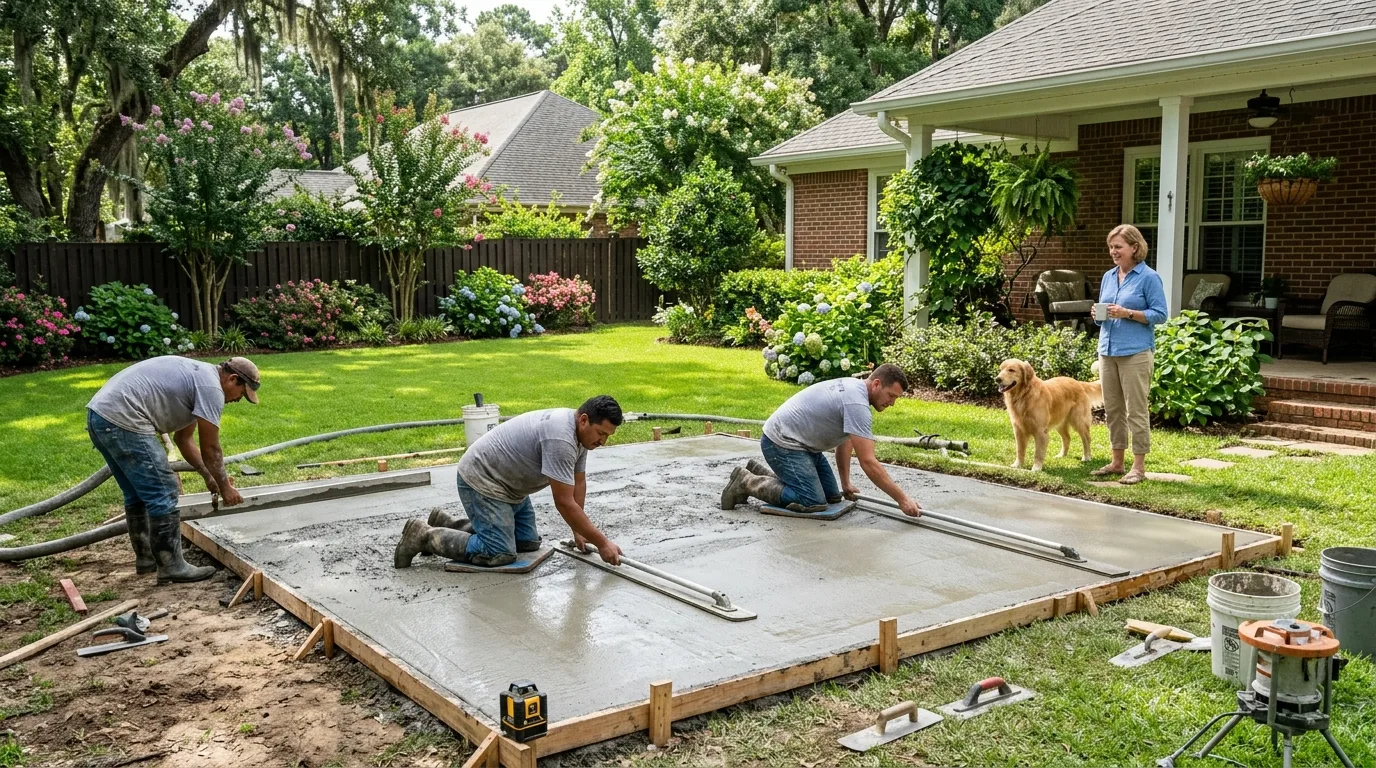
Stamped concrete patios are one of the fastest-growing home improvements in Rosenberg — and it’s easy to see why. They give Fort Bend County homeowners the look of natural stone, slate, or brick at a fraction of the cost, with the durability advantage of monolithic concrete over individual pavers that shift and separate on expansive clay soil. But stamped concrete is also more complex than plain concrete, and the difference between a beautiful long-lasting patio and one that fades and cracks within a few years comes down to installation quality and maintenance choices.
This guide covers everything Rosenberg homeowners need to know about stamped concrete patios: patterns, colors, costs, clay soil considerations, and what to look for in a contractor.
Get a Stamped Concrete Patio Estimate in Rosenberg
Rosenberg Concrete brings pattern samples and color boards to your property. Call (888) 376-0955 for a free design consultation.
Why Stamped Concrete Works Well in Rosenberg
Pavers — whether natural stone, brick, or manufactured — are popular for their appearance, but they have a critical weakness in Fort Bend County: individual units that can shift independently on expansive Houston Black Clay soil. When clay swells or contracts beneath a paver surface, individual pieces can rise, settle, and tilt at different rates, creating uneven surfaces, trip hazards, and gaps that admit weeds and water.
Stamped concrete solves this problem by being a monolithic slab — it moves as one piece, and control joints guide where cracking occurs if it does happen. In neighborhoods like Bonbrook Plantation and Millers Pond, where homeowners want high-end outdoor spaces on clay soil, stamped concrete consistently outperforms pavers for long-term surface stability.
Popular Stamped Concrete Patterns for Rosenberg Patios
Ashlar slate: One of the most popular choices in Fort Bend County. Mimics the look of cut slate with irregular rectangular shapes in a random pattern. Works in earth tones (tan, charcoal, brown) that complement Rosenberg’s predominantly brick and stone homes.
Cobblestone: Rounded stone patterns that give a European or old-town aesthetic. Popular for circular patio features and fire pit surrounds. Slightly more expensive to stamp than geometric patterns due to tool complexity.
Flagstone: Large irregular shapes that mimic natural fieldstone. Creates a rustic, organic appearance well-suited to Texas landscaping styles. Runs on the higher end of the stamped concrete price range due to tool size and pattern complexity.
Brick pattern: Running bond or herringbone brick patterns in red, tan, or charcoal are classic choices that work with virtually any home style. Often used for driveways, walkways, and pool surrounds in HOA-governed Rosenberg communities because they’re widely accepted under design guidelines.
Wood plank: A newer pattern option that mimics weathered wood. Popular for covered outdoor living areas where a warmer aesthetic is desired. Requires careful color selection to look realistic.
Exposed aggregate borders: Many Rosenberg homeowners combine a stamped field pattern with exposed aggregate borders — the contrasting texture creates visual definition without the additional cost of stamping the entire border area.
Color Options for Stamped Concrete Patios
Integral color is mixed into the concrete batch at the ready-mix plant or at the job site. It produces uniform color throughout the slab depth — so if the surface is damaged or ground down, the color persists. More expensive but more fade-resistant over time.
Color hardener is broadcast onto the concrete surface after placement and troweled in. It produces a rich surface color and also increases surface density, which improves durability. Most stamped concrete in Rosenberg uses color hardener because it provides better pattern definition and a wider color palette than integral color alone.
Release agent is applied before stamping and creates the secondary color that defines the pattern highlights. The release color is typically a contrasting tone — tan over charcoal, or brown over tan — that gives stamped concrete its realistic depth of color.
Antiquing agent is sometimes applied after stamping and before sealing to produce color variation and an aged appearance. It’s popular for flagstone and cobblestone patterns where color variation enhances realism.
How Clay Soil and Texas Sun Affect Stamped Patios
Houston Black Clay’s expansion-contraction behavior affects stamped concrete the same way it affects plain concrete — but visible cracking is more noticeable on decorative surfaces. A crack through a cobblestone pattern is far more visually disruptive than one in a plain gray slab. Placing control joints within pattern lines (inside the “grout joints” of a brick pattern, for example) makes any cracking that does occur minimally visible.
Texas UV radiation is the other major factor for stamped concrete in Rosenberg. Summer sun from June through September is intense, and unsealed stamped concrete fades dramatically within 2–3 seasons without fresh sealer. UV-resistant solvent-based sealers perform significantly better than standard water-based products for color protection in Fort Bend County’s sun exposure conditions. Resealing every 2–3 years is the single most important maintenance action for stamped concrete patio longevity.
What Stamped Concrete Patios Cost in Rosenberg
Stamped concrete runs $8–$21 per square foot in Rosenberg, compared to $4–$5 per square foot for plain gray concrete. A 300 sq ft stamped patio in a single-color ashlar pattern runs approximately $2,400–$3,600. A 400 sq ft multi-color flagstone patio with border treatment runs $4,000–$8,400.
Total project cost depends on:
- Pattern complexity: More complex patterns (cobblestone, multi-size flagstone) cost more in labor and stamp tooling than simple geometric patterns.
- Color system: Multi-color integral + hardener + release agent + antiquing adds more material cost than a simpler two-color system.
- Demo of existing material: Removing and hauling an existing concrete patio adds $1–$2 per square foot.
- Base preparation: Highly reactive clay sites may require deeper excavation and more base material.
- Drainage corrections: If the existing grade drains toward the house, correcting it before the new patio is poured adds cost.
Plan Your Rosenberg Stamped Patio
Call Rosenberg Concrete at (888) 376-0955. We bring pattern samples to your site and provide written estimates with no obligation.
How Stamped Concrete Compares to Pavers in Fort Bend County
| Factor | Stamped Concrete | Individual Pavers |
|---|---|---|
| Upfront cost | $8–$21/sq ft | $10–$30/sq ft |
| Clay soil stability | Moves as one slab | Individual units shift independently |
| Maintenance | Reseal every 2–3 years | Weed, level, and replace individual units |
| Repairability | Difficult to match color/pattern on repairs | Can replace individual units |
| HOA acceptance | Generally accepted | Generally accepted |
| Longevity | 20–30 years with maintenance | 15–25 years in clay soil conditions |
For most Rosenberg homeowners dealing with Houston Black Clay, stamped concrete offers better long-term stability than pavers at a comparable or lower cost.
Frequently Asked Questions
How long does stamped concrete last in Rosenberg?
Properly installed and maintained stamped concrete lasts 20–30 years in Rosenberg. The key maintenance step is resealing every 2–3 years to protect color from UV bleaching and surface from moisture infiltration. Proper base preparation and drainage design prevent the clay soil cracking that shortens patio life most dramatically.
Does stamped concrete crack in Fort Bend County’s clay soil?
All concrete can crack in clay soil conditions without proper engineering. Control joints placed within the stamp pattern’s “grout lines” guide cracking to minimally visible locations. Proper base preparation — 4–6 inches of compacted crushed limestone — and drainage slope design significantly reduce crack risk. See our guide on preventing concrete cracking in Fort Bend County for more detail.
How often do I need to reseal stamped concrete in Rosenberg?
Every 2–3 years for solvent-based sealers in Rosenberg’s sun exposure conditions. Signs that resealing is needed: color looks faded or dull, water no longer beads on the surface, or the surface feels rough and absorbs stains readily. Spring resealing (March–April) extends the fresh sealer’s protection through the intense summer UV period.
Related: