
How to Prevent Concrete Cracking in Fort Bend County
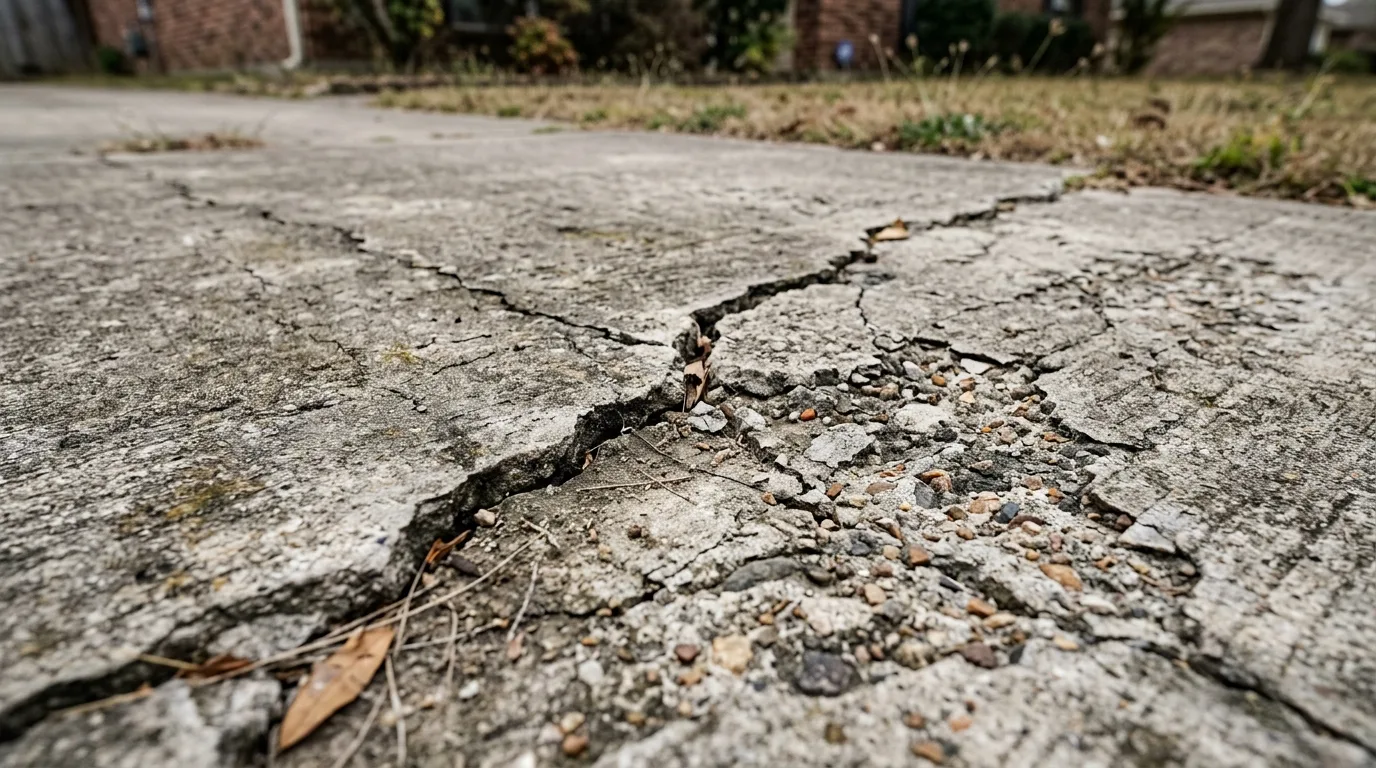
Every homeowner who has watched their Rosenberg driveway develop cracks that weren’t there two years ago has asked the same question: why does concrete crack here, and what can I do about it? Fort Bend County’s combination of Houston Black Clay soil and a humid subtropical climate creates crack conditions that differ from most of Texas. The good news is that concrete cracking in Rosenberg is largely preventable — with the right approach at installation time and modest maintenance afterward.
This guide covers the real causes of concrete cracking in Fort Bend County, what contractors should do to prevent it during installation, and what homeowners can do to extend concrete life after the pour.
Crack-Resistant Concrete in Rosenberg
Rosenberg Concrete engineers every pour to minimize cracking on Fort Bend County's clay soil. Call (888) 376-0955.
Why Concrete Cracks More in Fort Bend County
Concrete cracks everywhere eventually — it’s a naturally brittle material under tension. The question is where and how fast. In Fort Bend County, three factors accelerate cracking beyond what homeowners experience in other parts of Texas:
Houston Black Clay soil movement. The expansive clay beneath Rosenberg driveways, patios, and foundations generates upward pressure when wet and contracts when dry. This cyclic loading stresses concrete from below, eventually causing cracks perpendicular to the tension — typically at the weakest points in the slab, which should be control joints if they’re placed correctly.
Thermal loading from Texas summers. Concrete at 130°F surface temperature (common in Rosenberg’s direct summer sun) wants to expand. When restrained by adjacent concrete, structure, or soil friction, this thermal expansion generates compressive stress that dissipates by pushing at control joints and edges. Concrete that cools dramatically overnight after a summer day also contracts, producing tension that works the opposite direction.
Rapid surface drying during summer curing. Concrete placed in Rosenberg’s summer heat loses surface moisture faster than the interior cures, creating differential shrinkage between the surface layer (which wants to shrink) and the slab below (which hasn’t dried yet). This produces plastic shrinkage cracks — the fine surface-pattern cracking sometimes visible within hours of placement.
Prevention Strategy #1: Proper Control Joint Placement
Control joints are the most powerful crack prevention tool in Fort Bend County concrete. A control joint is a saw cut or formed groove that reduces the slab thickness along a line, creating a weak plane where the concrete will crack predictably — at the joint — rather than randomly through the slab.
Spacing rules for Rosenberg: Control joints should be placed at intervals of roughly 2–3 times the slab thickness in feet. For a 4-inch slab, joint spacing of 8–12 feet is appropriate. Joints should be placed at all re-entrant corners (inside corners where the slab changes direction), because these corners concentrate stress and crack first without joints.
Joint depth: Control joints must be at least 1/4 of the slab thickness to work. A 4-inch slab needs at least 1-inch-deep joints. Shallower joints don’t weaken the slab enough to direct cracking, and random cracks occur.
Timing: Saw-cut joints must be made within 4–12 hours of placement in Rosenberg’s summer heat — sooner than in cooler climates because concrete sets faster at 94°F. Waiting until the next day (common with less attentive contractors) means the slab has already cracked randomly before joints can be installed.
Prevention Strategy #2: Adequate Base Preparation
The sub-grade beneath Rosenberg concrete is the foundation of crack prevention. Houston Black Clay that’s allowed to experience large moisture swings generates more movement than clay that’s stabilized by a well-draining base layer.
Crushed limestone base, 4–6 inches: A properly compacted crushed limestone base creates a stable, well-draining platform that buffers the slab from clay movement below. This base layer also distributes loads more evenly across the clay sub-grade, reducing differential settlement.
Drainage slope: The base must be graded to slope away from structures at a minimum 1/4 inch per foot. Water that ponds against slab edges softens clay and creates differential wet/dry cycles at the most vulnerable part of the slab — the edges and corners.
Lime stabilization when indicated: On highly reactive clay sub-grades in neighborhoods like Kingdom Heights near the Brazos River corridor, lime treatment of the top 6–12 inches of native clay before placing base material significantly reduces clay movement amplitude throughout the slab life.
Prevention Strategy #3: Appropriate Concrete Mix Design
The concrete mix itself affects crack resistance in ways homeowners rarely consider:
Fiber reinforcement. Adding polypropylene fibers to the concrete mix (a standard concrete admixture) dramatically reduces plastic shrinkage cracking during the first 24 hours after placement. Fiber reinforcement costs relatively little and has an outsized impact on early-age crack prevention in Rosenberg’s summer heat conditions.
Lower water-cement ratio. Each additional gallon of water added to a concrete truck to improve workability reduces the concrete’s final strength and increases shrinkage. Concrete slumped out with added water (a practice called “retempering” on the job site) produces weaker, more crack-prone concrete. Specify maximum slump and prohibit field water addition.
Air entrainment. Air-entraining admixtures create microscopic air bubbles that provide relief points for internal stress, improving the concrete’s resistance to cracking from clay soil movement and thermal loading.
Prevention Strategy #4: Proper Curing
Curing is the post-placement period during which concrete gains strength. Short-cutting curing in Rosenberg’s summer heat produces concrete that gains surface strength faster than the interior, creating internal tension that causes early cracking.
Wet curing methods: Wet burlap or curing blankets laid over the surface within minutes of final finishing — and kept wet for 7 days — are the most reliable curing method in summer conditions. They prevent the rapid surface moisture loss that causes plastic shrinkage.
Curing compounds: Spray-applied curing compounds that form a moisture-retaining film over the surface work well for large areas where wet curing is impractical. They must be applied immediately after finishing.
Avoid plastic sheeting on summer concrete. Plastic sheeting can create uneven curing (the edges cure differently than the center), producing differential strength across the slab.
Practical Uses: Maintenance After the Pour
Once concrete is placed in Rosenberg, homeowners can extend its crack-free life through several practices:
- Seal regularly: Sealer reduces moisture penetration into the concrete and the sub-grade clay below, reducing the amplitude of clay wet-dry cycles. A well-sealed driveway has a more stable moisture environment than an unsealed one.
- Keep control joints clean: Remove plant growth from joints before root systems mechanically widen them. Use a flexible joint filler (not rigid cementitious material) to keep joints sealed against water but moveable.
- Address drainage promptly: If you notice water pooling against driveway edges or patios after rain, correct the drainage before it softens clay beneath the slab. Adding a drainage channel, regrading adjacent soil, or extending downspout discharge away from slabs are cost-effective drainage interventions.
- Fill cracks early: A $30 tube of polyurethane crack filler used at the first sign of a crack costs far less than a $3,000 resurfacing project two years later when the crack has widened and allowed water to undermine the base.
Frequently Asked Questions
Why does my new Rosenberg concrete driveway have cracks already?
New concrete cracking in Rosenberg most often results from plastic shrinkage during curing (surface moisture evaporating too fast in summer heat), missing or inadequate control joints (the crack occurred where a joint should have been), insufficient base preparation (clay soil movement below the slab), or added water to the mix on the job site (weaker concrete that cracks more readily). See our guide on concrete driveway maintenance in Texas for next steps.
Can I prevent all cracking in Fort Bend County concrete?
No concrete project is completely immune to cracking — it’s a natural characteristic of the material. What you can control is where cracks occur (control joints), how wide they get (sealing, drainage), and how quickly they propagate (maintenance). Properly engineered and maintained concrete in Fort Bend County cracks in predictable, manageable ways rather than randomly across the slab surface.
Is concrete cracking worse in Rosenberg than in other Texas cities?
Fort Bend County’s Houston Black Clay is among the most expansive soils in Texas, making concrete cracking more common here than in cities built on sand or limestone. Other Houston-area cities face similar challenges. The clay soil engineering practices that experienced Rosenberg contractors use — deeper base preparation, lime stabilization, closer joint spacing — reflect the specific demands of this soil type.
Build Crack-Resistant Concrete in Rosenberg
Rosenberg Concrete engineers every project for Fort Bend County's clay soil conditions. Call (888) 376-0955 for a free estimate.
Related: