
Houston Black Clay Soil and Concrete in Rosenberg, TX
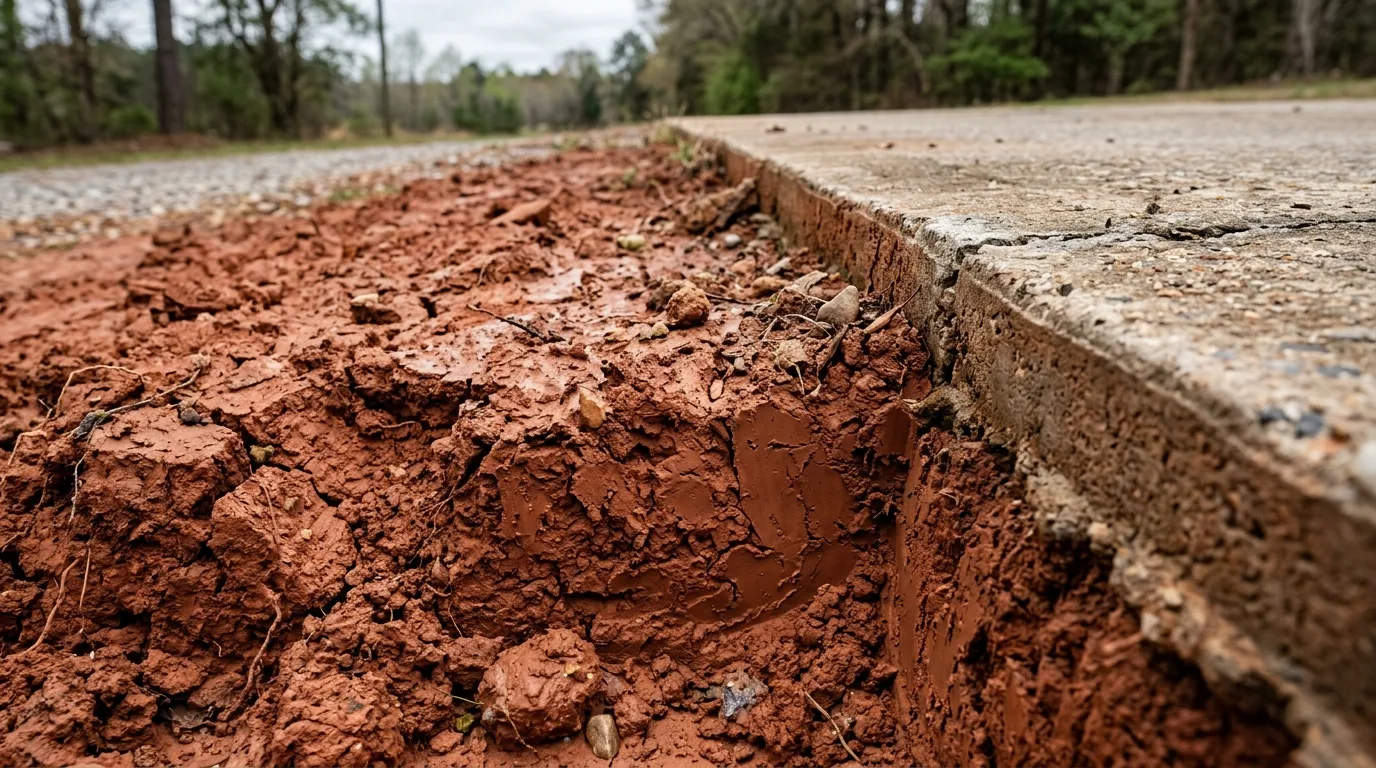
If you’ve lived in Rosenberg for any length of time, you’ve probably noticed the cracks that appear in driveways and patios that were just fine a few years ago. You may have noticed the giant gaps that open in your lawn during a dry summer. These are signs of Houston Black Clay soil — the most significant factor in concrete performance across all of Fort Bend County, and the reason that concrete work in Rosenberg requires a fundamentally different approach than in other parts of Texas.
In this post, we cover what Houston Black Clay is, how it affects every type of concrete project in Rosenberg, and what contractors should do to engineer around it.
Clay Soil Experts in Rosenberg
Rosenberg Concrete engineers every pour for Houston Black Clay conditions. Call (888) 376-0955 for a free project assessment.
Why Houston Black Clay Soil Matters in Rosenberg
Houston Black Clay is classified as an expansive soil — one of the most reactive in North America. Its high shrink-swell coefficient means it changes volume significantly with moisture content. In Rosenberg, where annual rainfall averages 52 inches and the Brazos River watershed raises groundwater seasonally, this soil goes through repeated wet-dry cycles every year. Each cycle generates vertical and lateral forces against any concrete placed on top of it.
The wettest months — May (5.1 inches), June (5.0 inches), August (5.2 inches), and September (5.0 inches) — saturate the clay and cause it to expand upward, pushing against slabs from below. Rosenberg’s summer drought periods, when temperatures hit 94–95°F and evaporation is high, dry the clay back out, causing it to contract and pull away from foundations and slab edges. This creates voids that allow slabs to flex under load, eventually cracking.
The cycle is not occasional — it happens every year, in neighborhoods across Fort Bend County from Bonbrook Plantation to Briarwood Crossing.
How Clay Soil Affects Different Types of Concrete
Driveways are the most commonly affected surface because they’re large, flat, and exposed to direct moisture contact at their edges. Without adequate base depth and drainage, the clay beneath driveway slabs absorbs rainwater, expands, and lifts sections — particularly at driveway edges where the clay is in direct contact with the slab side. When the clay dries and contracts, the slab drops back down, creating settlement cracks and uneven surfaces.
Patios and walkways face the same mechanism. Patios that drain toward the house concentrate water at the foundation edge, where it softens clay and accelerates settlement beneath the slab. Even a 1/4-inch-per-foot drainage slope away from the house makes a measurable difference in clay moisture stability and slab longevity.
Concrete foundations are where Houston Black Clay’s impact is most consequential. The entire Fort Bend County region builds on post-tension slab foundations specifically because conventional rebar slabs on expansive clay fail at unacceptably high rates. Post-tension systems resist the bending forces clay soil applies by pre-stressing the slab — allowing it to flex with soil movement without cracking. Lime stabilization of the sub-grade reduces clay reactivity before the foundation is poured, reducing the total movement the slab must absorb.
Retaining walls and concrete borders are particularly vulnerable to clay pressure because they’re vertical structures resisting lateral force from saturated soil. Without adequate drainage behind retaining walls, clay expansion can generate thousands of pounds of lateral pressure per linear foot.
What Contractors Should Do in Rosenberg
Proper base depth. The standard residential base in Fort Bend County is 4–6 inches of compacted crushed limestone placed over compacted native clay. This layer buffers the slab from direct clay contact, provides drainage, and distributes loads across a wider sub-grade area. Contractors who pour directly on native clay, or who use only 2 inches of base, are shortchanging your project.
Drainage design. Every concrete surface in Rosenberg should have a designed drainage slope that moves water away from structures and toward drainage swales or yard areas. The minimum slope is 1/4 inch per foot away from the house. Good contractors design this slope into the form layout before pouring — it can’t be added after the concrete is placed.
Lime stabilization when needed. On highly reactive clay sub-grades — common in many Rosenberg neighborhoods — lime treatment of the top 6–12 inches of native clay before placing the base layer significantly reduces future soil movement. This adds cost but is sometimes the difference between a slab that survives 30 years and one that shows serious cracking within 5.
Appropriate mix design. Fort Bend County soil often contains sulfate compounds that can react with standard Type I Portland cement over time. Specifying Type II cement, which has lower sulfate susceptibility, is a local best practice. Air-entrained concrete improves the mix’s ability to handle internal stress from minor soil movement.
Practical Uses: What This Means for Your Rosenberg Project
- New driveway: Ask your contractor specifically about base depth, soil compaction testing, and drainage slope design. If the quote doesn’t mention these, ask directly before signing anything.
- Patio installation: Verify that the drainage slope is designed away from your house, and ask whether the site’s current drainage pattern is adequate or needs correction before the pour.
- Foundation concerns: If you see stair-step cracks in brick, doors that stick, or gaps opening between walls and ceilings, you may be seeing Houston Black Clay soil movement affecting your foundation. Get a foundation assessment before they worsen.
- Older concrete replacement: Many Rosenberg homes built in the 1990s and early 2000s have original driveways and patios installed before Houston Black Clay engineering practices were widely understood. Replacement is an opportunity to do it correctly with proper base preparation.
How Soil Conditions Vary Across Rosenberg
Not all areas of Rosenberg have identical soil conditions. Properties closer to the Brazos River experience higher seasonal water table fluctuations, which amplify clay expansion during wet seasons. Neighborhoods in lower-lying areas near Seabourne Creek Nature Park may also have drainage patterns that concentrate moisture against slabs more than elevated sites. The Millers Pond and Kingdom Heights areas sit in different micro-topographic positions than elevated neighborhoods closer to US-90A.
The practical implication: a site visit matters. A contractor who gives you a firm quote on base depth without seeing your site’s drainage conditions and soil color is guessing.
Frequently Asked Questions
Why does my Rosenberg driveway keep cracking even though it’s only a few years old?
Premature cracking in Rosenberg driveways almost always traces to one of three causes: insufficient base depth (native clay beneath the slab is too close to the surface), poor drainage (water collecting against slab edges saturates and softens clay), or missing or inadequate control joints (cracks form at random rather than at designed locations). Read more in our guide on preventing concrete cracking in Fort Bend County.
Does lime stabilization really make a difference for Rosenberg concrete projects?
Yes, measurably. Lime reacts chemically with clay particles over several days, reducing the soil’s plasticity and shrink-swell coefficient. Studies in the Houston area show lime-treated sub-grades produce significantly less foundation movement over time than untreated clay. For high-reactivity soils and foundation pours, it’s often worth the added cost. For driveways and patios, a properly compacted gravel base is often sufficient if drainage is well-designed.
How do I know if my contractor is handling clay soil correctly?
Ask for a description of their base preparation process. A competent Rosenberg contractor should be able to tell you: base material type (crushed limestone is standard), compaction method, base depth, drainage slope design, and control joint spacing. Vague answers (“we do it right”) without specifics are a warning sign.
Build Your Rosenberg Concrete Project on the Right Foundation
Rosenberg Concrete engineers for Houston Black Clay from the sub-grade up. Call (888) 376-0955 or request a free estimate.
Related: