
Concrete Pool Deck Options for Rosenberg Homeowners
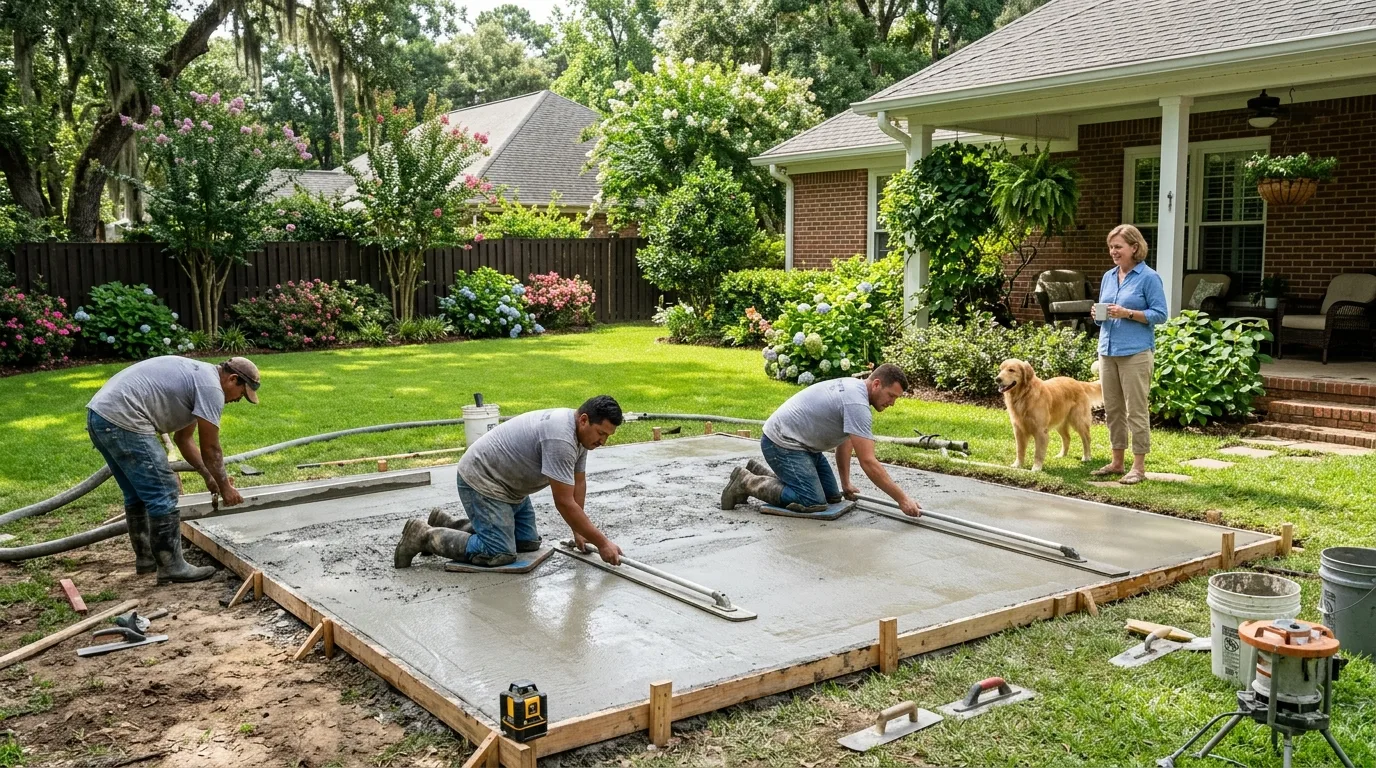
A pool deck in Rosenberg faces conditions that few concrete surfaces encounter anywhere else: 130°F surface temperatures in direct July sun, bare feet crossing the surface all summer, pool water splash and chemical exposure, and Houston Black Clay soil below trying to push the slab up every wet season. Choosing the right concrete option for a pool deck in Fort Bend County isn’t just about aesthetics — it’s about selecting a surface that stays safe, comfortable, and attractive through years of Texas summer use.
In this post, we cover every concrete pool deck option available to Rosenberg homeowners — from basic broom finish to exposed aggregate to stamped concrete overlays — with honest comparisons of cost, performance, and maintenance in this climate.
Free Pool Deck Estimate in Rosenberg
Rosenberg Concrete designs pool decks for Fort Bend County's clay soil and Texas summer conditions. Call (888) 376-0955.
Why Pool Deck Concrete in Rosenberg Requires Special Consideration
Three factors make Rosenberg pool deck concrete design different from other regions:
Surface temperature. In direct summer sun, dark concrete surfaces in Rosenberg reach 140°F+ — hot enough to burn feet within seconds. Surface finish, color, and texture all affect how hot a pool deck gets and how comfortable it is barefoot. Light-colored, textured surfaces run significantly cooler than dark smooth ones.
Slip resistance. Pool decks are wet environments where slip resistance is a safety requirement, not an aesthetic choice. Texas pool safety standards and common sense both demand surfaces that provide adequate friction when wet. Smooth concrete finishes are inappropriate for pool decks regardless of how they look.
Clay soil movement around the pool structure. Fort Bend County’s Houston Black Clay creates a particular challenge around in-ground pools: the pool shell itself is a rigid structure that doesn’t move with soil, while the surrounding concrete deck does. This differential movement — the pool staying fixed while the deck floats on clay — can cause deck sections to crack away from the pool coping over time if the joint between deck and pool isn’t designed for movement.
Option 1: Broom Finish Concrete (Basic)
Cost: $5–$8 per square foot Description: Standard concrete with a broom drag finish that creates linear texture ridges for slip resistance. Pros: Least expensive, adequate slip resistance, easy to maintain. Cons: Plain gray appearance, surface temperature can be high in direct sun, shows staining and wear more visibly than textured alternatives. Best for: Homeowners on tight budgets in Rosenberg who want a functional pool deck without decorative investment.
Option 2: Exposed Aggregate Concrete (Recommended)
Cost: $6–$10 per square foot Description: Standard concrete poured and screeded normally; surface paste washed away before final set to reveal natural stone aggregate. Pros: Excellent natural slip resistance from aggregate texture; significantly cooler underfoot than smooth concrete because aggregate reflects more heat; hides minor surface wear and staining better than smooth finishes; highly durable — the aggregate surface won’t chip or delaminate. Cons: Surface texture can be rough on sensitive feet depending on aggregate size; aggregate type and color choice is limited to what’s available from local ready-mix suppliers. Best for: Rosenberg pool decks where barefoot comfort, durability, and low maintenance are the priority. This is the most popular pool deck choice in Fort Bend County for practical reasons.
Aggregate color note: Lighter aggregate colors (cream, white, gray) stay significantly cooler than darker aggregates in Rosenberg’s direct summer sun. When selecting aggregate, consider color as a heat management decision, not just aesthetics.
Option 3: Stamped Concrete (Decorative)
Cost: $12–$21 per square foot Description: Concrete placed and stamped with texture patterns that mimic stone, slate, or tile; colored with hardener and sealed. Pros: High visual impact; coordinates with landscaping and home style; wide pattern and color selection. Cons: Higher upfront cost; requires resealing every 2–3 years to maintain color and slip resistance; stamped sealer can become slippery when wet without non-slip additive; summer heat fades unsealed stamped color faster than in cooler climates. Important requirement: Stamped pool decks in Rosenberg MUST include a non-slip additive (silica sand or aluminum oxide) in the sealer. Sealed stamped concrete without non-slip additive becomes dangerously slippery when wet. Any contractor proposing stamped pool decks should include this specification automatically. Best for: Homeowners in Bonbrook Plantation, Kingdom Heights, or other upscale Rosenberg neighborhoods where visual consistency with landscaping and home architecture justifies the additional investment.
Option 4: Concrete Resurfacing Overlay (Existing Decks)
Cost: $3–$7 per square foot over existing concrete Description: Polymer-modified concrete overlay applied over an existing structurally sound pool deck, then stamped, stained, or textured. Pros: Much lower cost than full replacement; can completely transform the appearance of an aging deck; allows modern finish choices on existing concrete. Cons: The existing deck must be structurally sound — overlays on cracked or heaving slabs will mirror the underlying damage. Overlay bond can fail if the existing concrete is contaminated or improperly prepared. Best for: Rosenberg homeowners with 10–20 year old pool decks that look dated but have no structural issues.
How to Handle the Pool Deck–Coping Joint
The joint between the concrete deck and the pool coping (the cap stone or concrete edge that finishes the pool’s top perimeter) is the most critical design detail for clay soil areas like Rosenberg. This joint must be:
- Filled with a flexible sealant, not rigid caulk or concrete: A polyurethane or silicone expansion joint sealant accommodates differential movement between the pool structure and the floating deck without cracking.
- Recessed slightly from the surface: So water drains away from the joint rather than pooling in it.
- Maintained regularly: Clay soil movement in Fort Bend County means this joint needs inspection and periodic resealing — typically every 3–5 years depending on movement.
Rigid joint filling (concrete grout, mortar, or rigid caulk) between the deck and coping is one of the most common pool deck mistakes in Rosenberg. When the clay moves, a rigid joint forces the coping to crack rather than allowing the joint to flex.
Frequently Asked Questions
What is the best pool deck concrete for Rosenberg, TX?
Exposed aggregate concrete is the most practical choice for Rosenberg pool decks — it provides natural slip resistance, stays cooler than smooth concrete in Texas sun, and is highly durable with minimal maintenance. Stamped concrete is the best decorative choice for homeowners who want high-impact aesthetics and are committed to resealing every 2–3 years.
How much does a concrete pool deck cost in Rosenberg?
Broom finish runs $5–$8/sq ft; exposed aggregate runs $6–$10/sq ft; stamped concrete runs $12–$21/sq ft. For a typical 400 sq ft pool deck, budget $2,000–$3,500 for exposed aggregate or $4,800–$8,400 for stamped concrete. Resurfacing an existing deck runs $3–$7/sq ft. Contact Rosenberg Concrete for a free, site-specific estimate.
How do I keep my Rosenberg pool deck from cracking?
Clay soil management is the key — proper base preparation, adequate drainage slope away from the pool area, and a properly sealed, flexible expansion joint between the deck and pool coping. Regular sealing of the deck surface reduces moisture infiltration into the clay below, which reduces clay expansion amplitude. Read more in our guide on preventing concrete cracking in Fort Bend County.
Build Your Rosenberg Pool Deck Right
Rosenberg Concrete designs pool decks for Fort Bend County's clay soil and Texas summer conditions. Call (888) 376-0955.
Related: